
Structured snippets are a Google Ads asset that adds specific details about your product or service to an ad. If you remember them as ad extensions, the current name has changed, but the purpose remains the same: they can present your services, product types, brands, amenities, or other relevant characteristics.
People cannot click the snippet itself. It gives them more reasons to pay attention and helps them understand what they will find before they follow the main ad link to your landing page.
What structured snippets are used for
Like other Google Ads assets, structured snippets make an ad larger. Extra lines appear after the headlines and descriptions, giving a potential customer a structured view of the offer.
A structured snippet appears as a header followed by a colon and a list of values. This extra information explains the offer more clearly. Individual words can catch a person’s eye, helping them judge the fit and decide whether to click the ad.
More useful information can improve the ad’s click-through rate. The cost per click may also fall if the quality and effectiveness of the advertising improve.
How to set up structured snippets in Google Ads
To set up structured snippets, open your Google Ads account and select “Campaigns.” These items are now found in the “Assets” section.
What I list in structured snippets
I use a structured snippet to list entities, not advertising claims. I choose the header first, then add values at the same level, such as types, models, or service categories. If one item answers a different question, I move it into a separate set because a mixed list does a poorer job of explaining the range before the click.
Google explains the purpose of each header and value in its official guide to structured snippets.
- Decide where to add the structured snippets:
- At account level, Google can show them with all ads.
- At campaign level, they apply to every ad group in that campaign.
- At ad group level, they are used only for the selected group.
The lower the level, the higher its priority. If structured snippets are added at campaign level, they can appear for every ad group. If a particular ad group has its own snippets, Google will show those instead of the campaign-wide set.
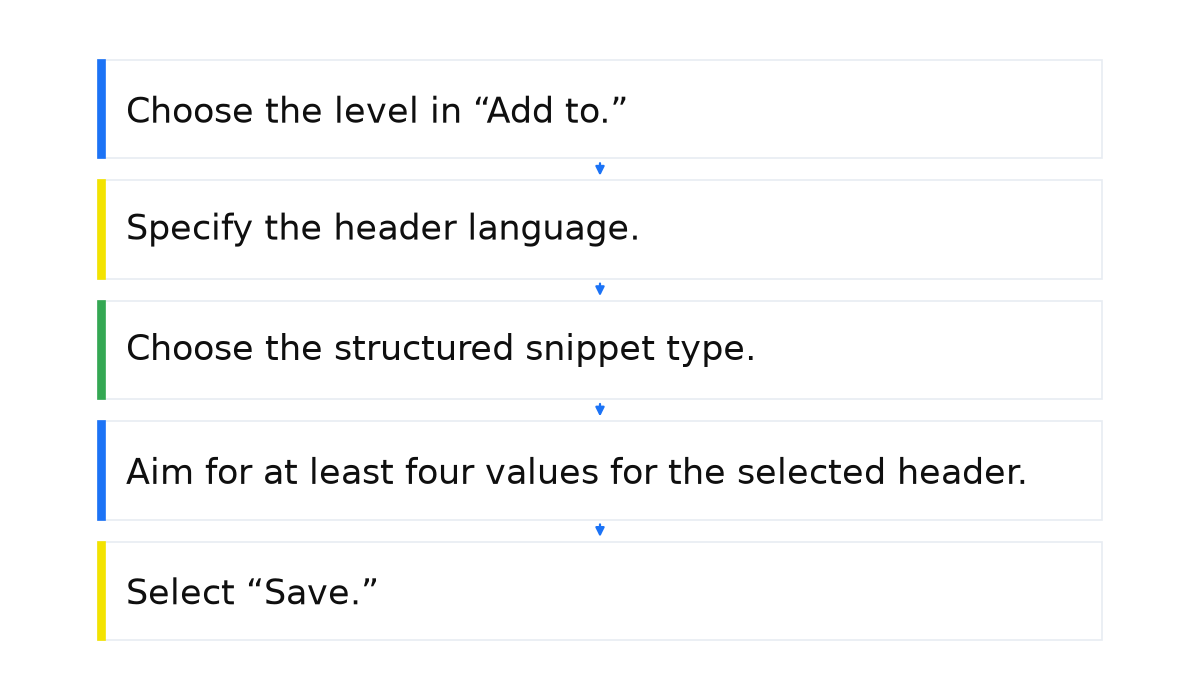
- In “Assets” under “Campaigns,” select “+”, then “Structured snippet.” Choose the level in “Add to.”
- Specify the header language.
- Choose the structured snippet type. Unlike callouts, structured snippets do not accept arbitrary information. You need to select the predefined header that fits your business. The list contains 13 headers:
- Brands, for example for electronics, footwear, clothing, or cosmetics.
- Neighborhoods, for example for a real estate agency.
- Courses, for example for educational institutions.
- Destinations, for example for travel companies or food delivery.
- Models, for example for cars or smartphones.
- Degree programs, for example for courses or universities.
- Featured hotels, for example for travel companies.
- Styles, for example for clothing or design services.
- Insurance coverage, for example for insurance companies.
- Types, which can work for many kinds of businesses.
- Amenities, for facilities at a building or place.
- Service catalog, for specific services provided for a fee.
- Shows, for example for theaters.
- Aim for at least four values for the selected header. Enter each one in a separate field without punctuation.
- Select “Save.”
Repeat steps four through six until you have covered every suitable header. If you need help choosing and combining assets, start with the complete guide to Google Ads assets and their setup.
My e-book “19 Google Ads Secrets”: how to get the most out of Google Ads without draining your budget, drawn from real campaigns and tests.
See the book →The most versatile structured snippet types
The right header depends on what you can list. “Types” covers product categories, “Amenities” covers facilities at a place, and “Service catalog” covers paid services. For example, the following services belong under “Service catalog”:
- For an auto repair shop: wheel alignment, tire fitting, computer diagnostics.
- For a law firm: criminal, administrative, commercial cases.
- For a medical center: endocrinology, therapy, surgery.
Use “Amenities” for actual facilities at a building or place. For a hotel, examples include:
- Swimming pool.
- Wi-Fi.
- Gym.
A retailer can use “Service catalog” if it also provides paid services. For example, an automotive business could list:
- Oil change.
- Tire alignment.
Tips for adding structured snippets correctly
Use the following practical rules to get more value from structured snippets in Google Ads.
- Add several structured snippets rather than just one. Choose every header that relates to your business and create each asset in turn. Relevant options might include Types, Courses, and Service catalog.
- List at least four values for every header, preferably five or more, up to ten. This gives Google options to rotate and select more relevant values for different search queries. Review performance for the structured snippet asset as a whole. The report does not isolate individual values or their combinations.
- Keep every value as short and concise as possible. More values can then fit into the ad, giving a potential customer more information and choice.
- Follow Google’s structured snippet requirements to help your assets pass review:
- values must match the meaning of the selected header;
- text must not be repeated;
- under “Brands,” list only real brands you offer and comply with Google’s trademark policy;
- extra details such as model prices, course lengths, clothing sizes, or a car’s model year cannot be added.
- If an advertiser does not add structured snippets manually, Google may display dynamically created snippets. Manual assets give you more precise control over what a person reads on a mobile device or computer.