
Alexey Kokoshin sold yacht trips and tours in a niche with very little existing demand. Before training, he had changed contractors twice without getting the result he needed. He then learned to manage the campaign himself, launched and refined it, reviewed his settings and website in a consultation, and began receiving more search inquiries at a lower cost.
The value of this case is not a promise that another operator will reproduce the outcome. It offers a better frame: yacht charter advertising cannot be judged by the traffic expectations of a mass-market service. You first need to understand the available demand, then examine the route from search query to inquiry. The broader guide to diagnosing clicks without leads explains how to inspect that route.
What happened before the training
This was not a single unsuccessful launch. Alexey had already delegated the advertising to specialists and had also tried working from free templates himself. Describing the contractor experience, he said: “After changing two people, I realized that neither of them could deliver results.”
That does not mean yacht businesses should avoid contractors. The difficulty lies elsewhere. In a very narrow niche, an owner cannot hide weak targeting behind a large volume of statistics. If a campaign attracts the wrong people, waiting for more data without changing its logic consumes scarce demand.
“I have a fairly difficult niche: there are few such trips, not many people know about them yet, and few people search for them.”
Alexey Kokoshin
Another detail shows the scale of that constraint. Alexey considered 25 clicks in a day a substantial volume for his narrow niche. That describes his assessment of the available traffic; it does not establish how many clicks another operator needs to attract enough customers. It explains why raw traffic volume is a poor verdict on performance in this market.
What Alexey changed
Alexey completed the School of Contextual Advertising course in a week while applying the lessons to his own project. After launch, he continued refining the campaign for two to three weeks. He then booked a consultation focused on his specific settings and website.
The sequence reveals the mechanism behind the result. The owner did not stop at a template or outsource responsibility for the meaning of the campaign. He learned the basic system, tested it against real demand, identified questions specific to his niche, and then used the consultation to examine them.
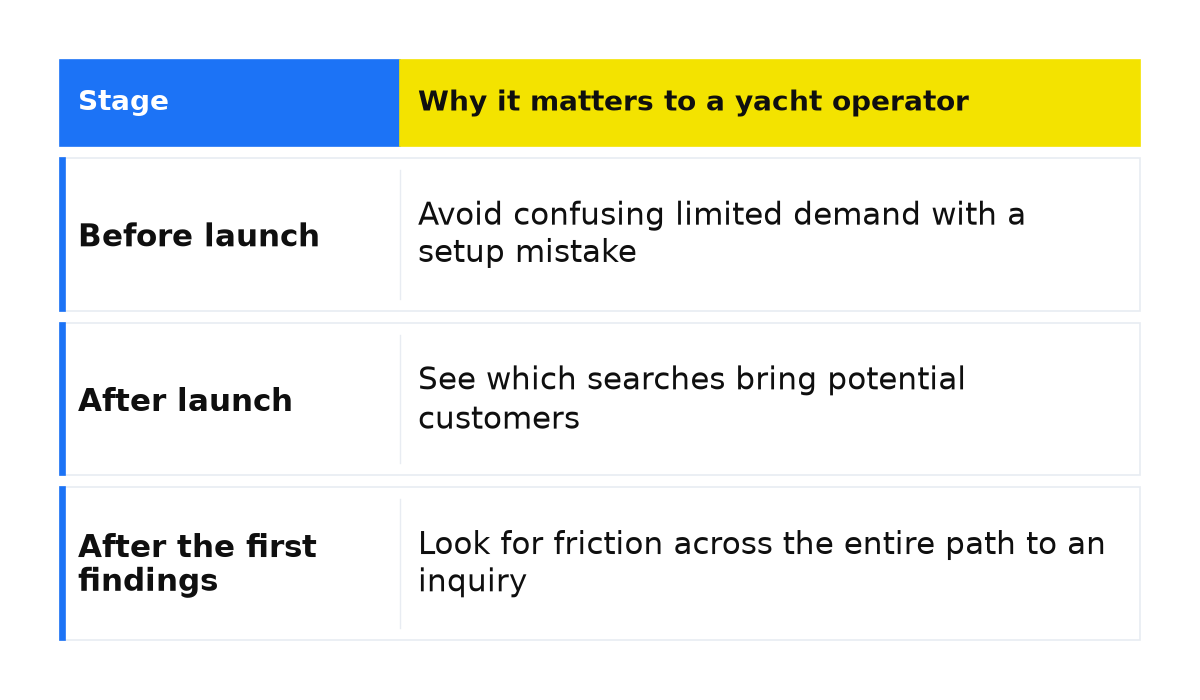
| Stage | Decision in the case | Why it matters to a yacht operator |
|---|---|---|
| Before launch | Understand the campaign logic personally | Avoid confusing limited demand with a setup mistake |
| After launch | Refine the advertising using live data | See which searches bring potential customers |
| After the first findings | Review the settings and website in a consultation | Look for friction across the entire path to an inquiry |
Search then began producing inquiries. Alexey described the outcome this way: “This allowed me to increase conversion, that is, get more inquiries, and they became cheaper.” The case provides no growth percentage or amount saved, so the responsible conclusion is qualitative: inquiries increased and their cost fell.
What to do in the same niche
- Accept the real scale of demand. A small number of clicks is not automatically a failure. Check whether the searches match the kind of yacht experience you sell.
- Separate traffic from the outcome. A click shows interest, but the business needs an inquiry. Examine what happens after a visitor reaches the website.
- Explain an unfamiliar product. If few people know about this type of trip, the page must quickly clarify what you offer and whom it suits.
- Keep working after launch. Use actual search queries and visitor behavior to refine both the campaign and the page.
- Retain informed control. Even with a contractor, the owner should know what demand the campaign buys and which action defines success.
When this does not apply
This approach cannot create search demand where none exists, and it does not guarantee Alexey’s result for another business. If people do not search for your kind of trip, a search campaign cannot replace awareness building. It also cannot rescue an offer that visitors do not understand after clicking. First confirm that relevant searches exist, the page communicates the offer, and inquiries are recorded.
Questions and answers
Are 25 clicks a day enough for yacht charter advertising?
The click count alone cannot answer that. Alexey considered it substantial for his niche, but whether it is enough for your business depends on the resulting inquiries and their cost. Check those outcomes against your own business needs.
Does the owner need to manage Google Ads personally?
The owner does not have to perform every task. They do need to understand the campaign logic well enough to assess a contractor and distinguish limited demand from a problem in the advertising or website.
If you want a structured way to review yacht charter advertising, the next step is to connect demand, campaign settings, and the full path from a search query to an inquiry.
My e-book “19 Google Ads Secrets”: how to get the most out of Google Ads without draining your budget, drawn from real campaigns and tests.
See the book →