
A competitor might win attention with a strong ad, persuade visitors with a useful website or handle inquiries more effectively. To find improvements for your own business, I recommend following that company’s customer journey from a Google search through to a conversation with its team. This shows you what happens after the ad has done its job.
When should you analyze competitors?
Competitor research is useful both online and in the physical market. It can inform your decisions before launching an advertising campaign, when you want to grow the business, or when customer activity drops and the market becomes more difficult.
Choose a scope you can manage: how many companies you will study and who on your team will do the work. Revisit the comparison regularly and use what you learn to improve your advertising, website and customer support.
Identify your online competitors
First, work out who competes with you online. For an auto repair shop, the obvious local rival may be the garage on the next street. The businesses competing for the same customer’s attention in Google can be different.
Look for companies in your field that advertise for the same searches in the same location. Include businesses that appear prominently in both paid and organic results for those searches. These are the offers a potential customer is likely to compare with yours.
What to examine in a competitor review
Follow as much of the customer journey as you can. Imagine you need the product or service: find the ad, explore the website, observe the follow-up and speak with the team. Record what makes the experience useful and what makes it difficult.
Search queries
Start with the words people use to look for your service in Google. Think about the job the customer needs done.
- For an auto repair shop, searches might include “car repair,” “tire fitting” or “brake pad replacement.”
- For a medical practice, combine “consultation” with the relevant specialty.
- For a beauty salon, try “haircut,” “highlights,” “manicure” and “pedicure.”
Use the results to identify companies for your comparison. Set up a table at the start and record useful information as you work through the research.
Ad copy and assets
Read each ad as a potential customer. Which keywords does the competitor use? What action does the ad ask you to take? Which additional ad assets appear? Save wording that attracts attention and makes the offer clear.
Use the data available in Google Ads to compare advertising visibility. The Auction insights report lets you compare your auction performance with other advertisers. Third-party services such as Serpstat can support additional advertising research.
The competitor’s website
Open the landing page used in the ad. Consider how easily a potential buyer can understand the offer and take the next step.
Review the range of products or services, the brands offered, prices, payment options, delivery terms and guarantees. Look for staff photos, customer reviews, a blog, videos and other images. Together, these details show how the company presents itself to a customer.
Record the ways a visitor can get in touch: registration fields, email signup forms, online consultation requests and callback buttons. Check how easy each option is to find on the page.
Email follow-up
Subscribe with your own email address to see how the company continues the conversation. Record which emails arrive, the offers they contain and how often they are sent. Save the wording and sequence so you can compare them with your own email communication.
Remarketing activity
After visiting the website, you may become part of the competitor’s remarketing audience. Pay attention to the banner ads you encounter afterward. Turn off your ad blocker for this observation, since it would prevent you from seeing the ads you want to review.
Record the websites where the banners appear, what the banners look like and the pages they lead to. Screenshots will help you preserve the creative and compare it with the competitor’s other messages.
Social media activity
On Facebook, watch for advertising related to your field. Study how the promotional posts are constructed and which pages they send people to. You can also use the Ad Library to look at ads.
Review the competitor’s presence on Instagram, TikTok and YouTube too. Note how the business presents its offer on each platform and where it directs people who want to know more.
How the team handles customer inquiries
Call the business with the kinds of questions a prospective customer would ask. Assess the representative’s knowledge and willingness to help. Can they explain the offer clearly? Do they try to understand what the caller needs?
Notice how the representative creates interest, keeps the conversation going and proposes a next step. This reveals how actively the team works to win the customer once advertising has brought that person to the business.
Organic search visibility
Find the competitor’s website in Google’s unpaid results for the relevant searches. Record its position and compare its visibility with your own site.
For a closer look, consider keyword research tools such as Serpstat and traffic analysis tools such as Similarweb. These can supplement your manual searches with information about the topics and channels through which competitors attract visitors.
How to organize your competitor research
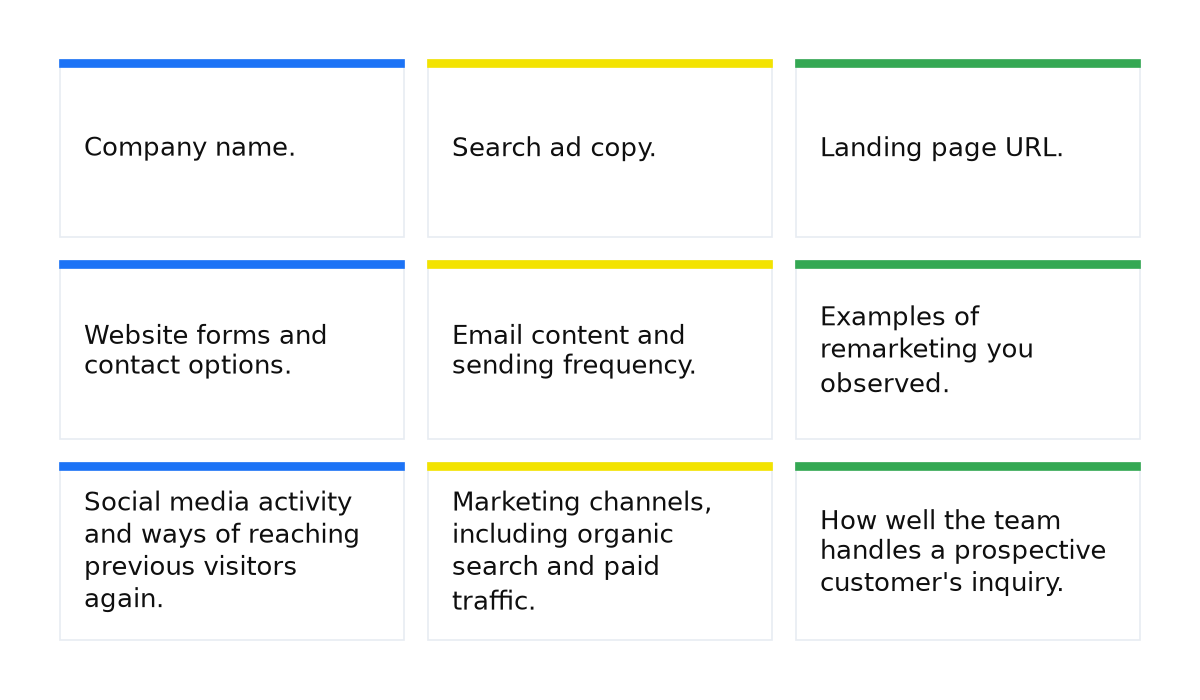
Keep the findings in one comparison table. For each company, include fields for the following information:
- Company name.
- Search ad copy.
- Landing page URL.
- Website forms and contact options.
- Email content and sending frequency.
- Examples of remarketing you observed.
- Social media activity and ways of reaching previous visitors again.
- Marketing channels, including organic search and paid traffic.
- How well the team handles a prospective customer’s inquiry.
Compare these observations with your own business. Look critically at your ads, website and each subsequent step in the customer journey. Which opportunities are you already using, and which parts need improvement?
What competitor analysis gives your business
You can begin this manual research without paying for specialist tools. It can help you find useful ideas, spot mistakes, prepare for budget planning and identify weaknesses in competing offers. You will also see how other businesses maintain interest and encourage customers to buy.
Choose several of the largest relevant competitors and collect the most useful observations from each. Use those findings to build a plan for improving your website, search advertising and social media activity.
Apply the ideas that fit your business and evaluate the results. The aim is to make your offer more appealing and the path to an order easier to follow. Changes in traffic, conversions, sales and profit will show whether your improvements are doing useful work.
When this does not apply. Copying another company’s ads does not give you a complete strategy without considering your own offer and customers. A website or ad cannot reveal a competitor’s profitability, and failing to see a banner does not prove that the business has no remarketing. Treat your observations as ideas to test in your own business.
Once your comparison table is ready, turn it into specific advertising decisions: which searches to test, what to change in your ads and how to align them with the landing page. Learning Google Ads will help you make those changes yourself and assess what they achieve.
My e-book “19 Google Ads Secrets”: how to get the most out of Google Ads without draining your budget, drawn from real campaigns and tests.
See the book →