
A business can be interested in your service long before it is ready to buy. Your advertising needs to help the person making that decision understand the offer, assess how it fits their company and take a practical next step.
Identify who makes the buying decision
B2B means one business sells a product or service to another. A person still decides whether to buy. A business owner, an employed director and a manager may judge the same offer by different criteria. Your marketing strategy depends on understanding whose decision you need to influence.
- Which queries you target with search advertising.
- Which audiences you select for Google Display Network and YouTube ads.
- Which websites you choose for B2B advertising placements.
Start with your sales team. Ask who they deal with when closing a sale and who approves the purchase. Their experience can help you identify the person your ads and landing pages need to address.
Plan for more than one contact
In B2C, a customer may buy on the first visit. Someone breaks their iPhone, sees a search ad for repairs, clicks through and books the service immediately.
Which lead I treat as a useful B2B signal
With a long sales cycle and several contacts, I do not treat a form submission as the final result. When feedback from the sales process is reliable, I move optimisation closer to the qualified lead and keep earlier actions as diagnostic signals.
Google explains how to use qualified lead and converted lead goals in its official guidance.
B2B decisions often take longer. That makes the number and substance of your contacts with a prospective buyer important throughout the decision period.
Use remarketing to answer the next question
Thoughtful remarketing helps a prospect understand your product. Sending the same person back to the same landing page with the same message gives them little reason to reconsider the offer.
Picture someone who has visited the page for your SaaS product, or software as a service. Their next question may be how it would work in their industry. Your remarketing can answer that question with case studies, product explanations and examples of implementation in different businesses.
Consider how long someone stays on your remarketing lists. Showing an identical message for 365 days makes little sense. Estimate the typical decision period, divide it into stages and use different ads at each stage. Each contact should help the buyer learn something more about the product’s value.
Remarketing that spends money for months without generating enquiries deserves investigation. A systematic Google Ads audit can help you find these areas of wasted spend.
Your website can also encourage visitors to follow your social accounts. A follower may later become a lead. Useful posts and creative work can maintain that relationship, attract prospective customers and bring people back to the website.
Make the first step easy to take
A landing page that immediately asks a B2B prospect to order and pay can demand too much too soon. When the purchase involves a substantial commitment, that first step may put the buyer off.
Offer a simple step that requires no initial payment: a trial period or a free consultation about implementing the product. It is stronger when the prospect’s business gets something useful from that first interaction.
- If your product simplifies financial reporting, offer a small review. A specialist can examine the company’s reports, suggest improvements and explain how your product could help.
- If you sell video equipment, offer to assess the client’s picture quality, colour balance, colour temperature and studio setup. Your specialist can review the existing equipment and suggest useful additions.
Build trust by helping buyers learn
Teaching prospective customers helps them understand the value of your offer. A buyer who knows little about the subject may struggle to follow your arguments. Once they understand the basics, it becomes easier to explain why particular product features matter.
Use articles and videos to provide that foundation while the buyer considers their options. Several channels can help those materials reach the right people.
- Dynamic Search Ads can bring readers to your website’s blog.
- Video advertising can attract viewers to your YouTube channel.
- Facebook or Telegram chatbots, email and SMS can maintain contact with people already in your CRM. Share ways to use the product in their business, invite them to webinars and conferences, and tell them about promotions.
Connect the full B2B customer journey
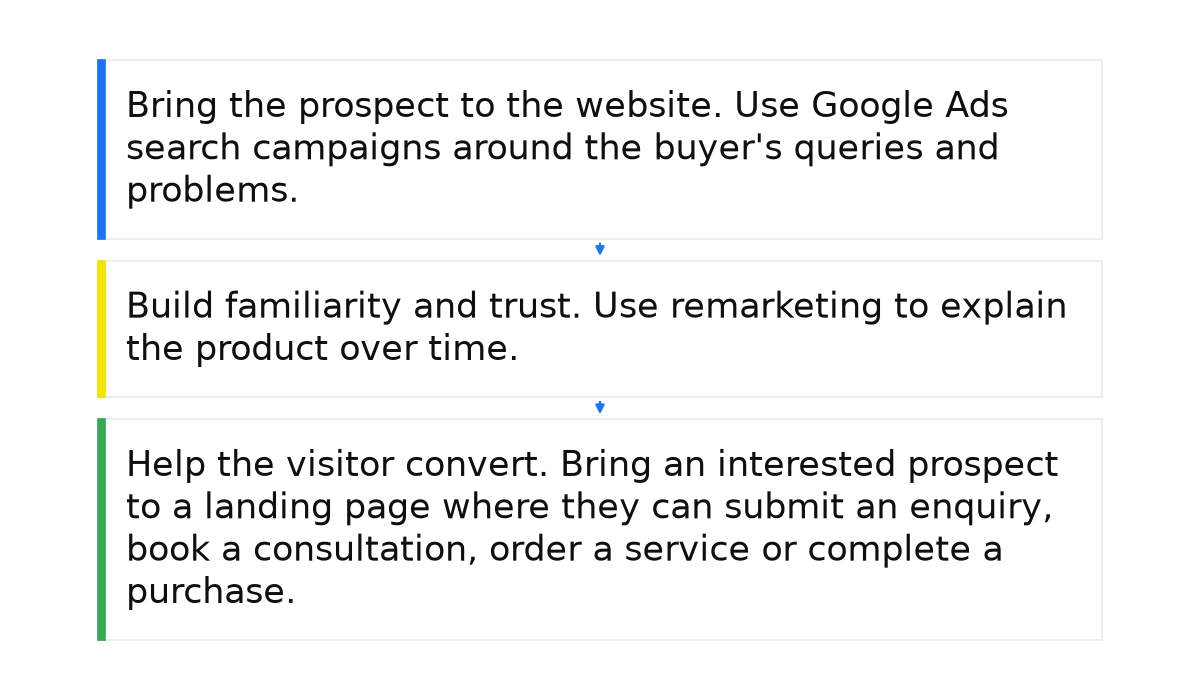
A B2B marketing funnel can be organised into 3 stages, each with a different job and a suitable set of tools.
- Bring the prospect to the website. Use Google Ads search campaigns around the buyer’s queries and problems. Dynamic Search Ads can lead to blog content. YouTube video ads and Display Network banners can reach audiences based on interests and intent, with custom segments available for suitable campaigns.
- Build familiarity and trust. Use remarketing to explain the product over time. Channels can include the Display Network, Gmail within Demand Gen, YouTube and search remarketing when a previous visitor searches for something related to your services.
- Help the visitor convert. Bring an interested prospect to a landing page where they can submit an enquiry, book a consultation, order a service or complete a purchase. At this point, remarketing supports a specific action.
Put the B2B marketing plan together
- Research your market, demand and competitors’ offers. Define the person your company and product advertising need to reach.
- Combine paid advertising, social media and useful website content. Work on SEO to improve your visibility in Google’s organic results.
- Use analytics to optimise campaigns and manage the budget.
- Automate repetitive marketing work to reduce the time spent on advertising and support revenue growth.
For a service business, connect these activities to the full journey from the first ad click to a genuine enquiry. That makes it easier to see where advertising helps and where the buying process needs attention.
When this does not apply: repeated ads cannot resolve a buyer’s doubts if every visit leads to the same page without useful new information. Optimising towards qualified leads also depends on reliable feedback from your sales process; without it, you cannot consistently assess the quality of the enquiries advertising brings in.

Apply this sequence to your own business: identify the decision maker, choose a useful first step and decide how you will measure lead quality. Those decisions give you a practical foundation for learning how to manage Google Ads.
Ready-made ad copy brings clicks; bookings come from the whole chain up to the call. My e-book “19 Google Ads Secrets” shows how to get the most out of Google Ads without draining your budget, drawn from real campaigns and tests.
See the book →