
When you build a Search campaign in Google Ads, you pick keywords for the niche and you pick a match type. Keyword Planner helps you expand the list. Match type decides how wide Google may stretch those words. This article covers exact match: what it is, how it fires, and how owners in the US, Canada and the UK should use it without treating brackets as a hard lock.
Exact match is on when a keyword sits inside square brackets. Example: [custom curtains near me]. Reach is smaller than broad or phrase. You deliberately shrink the zone of impressions instead of letting every loosely related query spend $.

Exact match can include close variants with the same meaning or intent.
The search-terms report and negatives still define the boundary.
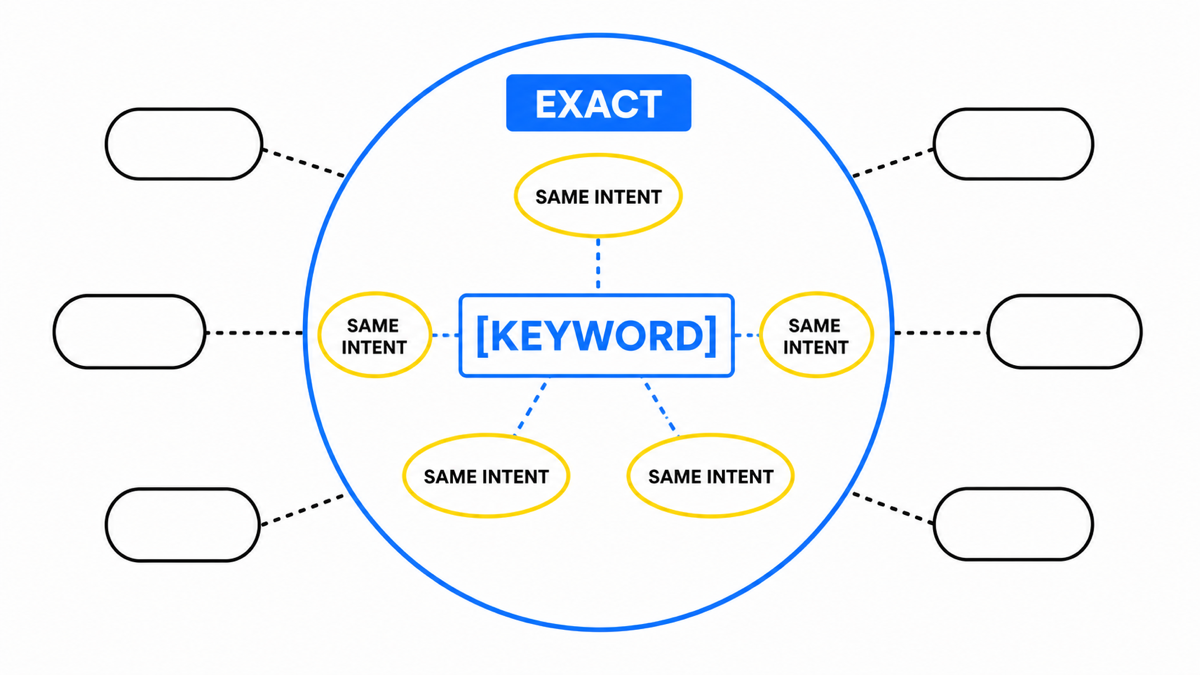
How exact match behaves and how to use it well
Exact match is built for high relevance and lower reach. You constrain Google and state the intents you care about. In practice that means:
- Exact match uses square brackets. Example: [keyword].
- You usually need more distinct keyword lines for different meanings, even when they look related. Do not add two lines that are only a word-order swap of the same set. Phrase match on “buy laptop” can cover “laptop price” or “order laptop”. Exact match often needs each meaningful variant listed. You still do not need both “buy laptop Austin” and “laptop buy Austin”.
- Exact match works with automated bidding, but it is not a full substitute for search terms control. The real win is tighter intent control: you limit the zone first, then clean close variants with negatives.
- You still watch impression stats and negatives, because Google matches close variants, synonyms and similar intent, not only the literal string.
- A useful structure: two campaigns. Campaign A runs broad match with Maximize conversions and a target CPA you can afford in $. Converting search terms move into campaign B as exact match. Campaign B can stay on automated bidding once volume is stable, or use manual CPC for a careful test.
- Exact match is about control and hands-on semantic work. Without a habit of reading the search terms report, it is a poor default for a first-time advertiser.
How exact match actually matches
Older exact match was closer to a near-literal string match. The product changed. Today exact match is about the same meaning or intent, not only the same characters.
Why I do not treat exact match as literal
I use exact match for a managed intent core, not as a promise that every query will match character for character. Brackets mean a narrower meaning band, not a ban on close variants. I write ads for the intent and judge the real search terms, instead of inflating the list with every stem and word order.
Google’s documentation states that exact match covers the same meaning or intent.
When the ad does not show
An exact match keyword usually will not serve if the query adds extra words before or after the core idea in a way that changes the match (unlike phrase match in quotes). Example:
- Keyword: [custom curtains in Austin];
- Query that typically will not match that exact keyword: custom curtains in Austin for bay windows.
When the ad can still enter the auction
Exact match can still serve on queries that are very close to the keyword without being identical. Google may show the ad when the search includes:
- The same words with misspellings or typos.
- Different word forms (singular or plural): curtain custom made in Austin.
- Close stems: curtains to order in Austin.
- Abbreviations: [oil change] ≈ OIL CHG style shortenings people type.
- Reordered words: Austin custom curtains.
- Function words added or dropped: curtains order Austin.
- Synonyms and rephrasing: [swimsuits] ≈ bathing suits.
- Same search goal in Google’s judgement: [royalty tax] ≈ a close legal phrasing with the same intent.
- Implied words people associate with the phrase: curtains Austin.
Once you can see which lines bring enquiries and which only spend $, the next useful move is to park proven phrases in exact match and negative out close variants with the wrong job.
Tags and reports matter when they show payback. My e-book “19 Google Ads Secrets” shows how to get the most out of Google Ads without draining your budget, drawn from real campaigns and tests.
See the book →How to steer impressions with negatives
Compare “custom curtains Toronto” and “curtains Toronto”. Similar words, different buyer and different business model:
- “Custom curtains Toronto” more often means made-to-measure work with a tailor or workshop.
- “Curtains Toronto” more often means ready-made product from a store.
The second group is usually larger. Without negatives, spend can shift to people who do not want custom work. Traffic lands on a page that does not match the job they had in mind.
So exact match still needs negatives. If you sell custom work, a ready-made retail query pattern can go on the negative list inside the Search campaign setup in Google Ads.
Frequently asked questions about exact match
Takeaways on exact match
Even in English, exact match is not a literal lock. Advertisers expect only tightly relevant queries; Google still expands to synonyms, implied words and similar goals. Irrelevant spend is still possible inside brackets.
To protect budget, review search terms on a schedule. Add negatives for phrases that do not fit the business. That improves relevance, supports CTR and reduces $ spent on people who will never buy.