

If your passenger transport ads suddenly spend more and appear far more often, do not immediately raise the budget or shut everything down. First identify where the impressions appeared and whether they produced calls or genuine enquiries.
For a transport company, the useful outcome is not an impression or even a click. It is contact from a passenger about a relevant route. Diagnosis therefore starts with enquiry tracking. The broader process is covered in this guide to diagnosing clicks without leads in a service business.
How much does Google Ads cost for a passenger transport business, and is it worth it?
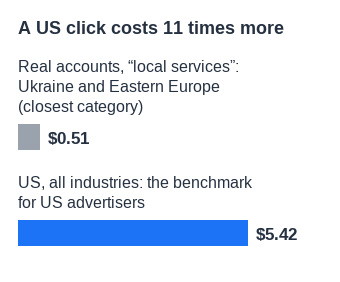
Across all US industries, the median search click costs about $5.42 (WordStream/LocaliQ 2026). In our real ad accounts, mostly in Eastern Europe, a click in “local services” costs about $0.51 (2025 median): a cheaper market, relevant only if you advertise there. There is no separate measurement for this exact niche: this is the closest category in our real accounts. Figures in this block are for 2025; the article below may mention prices from other years. Where the figures come from ↓
Real accounts = ad accounts managed by Igor Ivitskiy's team, mostly in Eastern Europe.
A $1,500 monthly budget → about 275 clicks → about 25 (19–40) conversions at this industry's US median of 8.18% (a call, a form or a purchase).
To get about 30 leads a month (a practice rule: with that many, Google's automated bidding runs more steadily), you would need about $1,988 a month.
An estimate, it may not hold.
Estimate your budget
A rule from Igor Ivitskiy's practice: automated bidding needs about 30 conversions a month to have enough data. A scenario, not a measurement or a promise.
| Metric | Real accounts (mostly Eastern Europe) | US (WordStream/LocaliQ 2026) |
|---|---|---|
| Cost per click | $0.51 | $5.42 |
| CTR (clicks per impression) | 5.28% | 6.64% |
| Leads (conversions) per 100 clicks | no data | 8.18% |
| Cost per lead | no data | $67 |
- For a typical advertiser in the “local services” category (median), about 57.7% of tracked search spend goes to queries without a single conversion (2023 to 2025). Before raising the budget, review your search terms and cut the useless ones.
- In the “local services” category a click is usually cheapest in June (about $0.41) and most expensive in July (about $0.48): monthly medians over the whole observation period.
- Data covers only some months of the year.
Where the figures come from
Panel: the open “Ivitskiy Ads Lab Google Ads Panel & Benchmark Compilation 2026” dataset (version 1.0, CC BY 4.0) on Hugging Face and GitHub; real managed ad accounts, mostly Eastern Europe (business country is not recorded in the primary data); a convenience sample, not a market norm; dollar amounts at a fixed mid-2026 exchange rate.
Unit of observation: advertiser; median across advertisers in the category for the year (6 advertisers in “local services” over the whole period).
US: WordStream/LocaliQ “Google Ads Benchmarks 2026” report, medians across LocaliQ client search campaigns (called averages in the report), Google and Microsoft combined, April 2025 to March 2026; a conversion there can be a call, a form or a purchase.
Updated: 2026-09-24 · release r1
Hugging FaceGitHubDownload the values (CSV)Yuri’s story: a self-built campaign and abnormal reach
Yuri runs a small passenger transport company in Moldova. Competition on his route intensified, including the launch of a flight at a heavily discounted price. He had set up the business profile and advertising himself through the mobile app. The prompts made launching easy, but did not explain how each confirmation could change traffic or spend.
After a year, the campaign’s behaviour changed sharply. In translation, Yuri described it this way:
«A year later, Google Ads started charging huge amounts, racking up hundreds of thousands of views overnight»
He was seeing a sharp increase in impressions overnight alongside much heavier charges. The translated testimonial uses the everyday word views, but the advertising metric in question is impressions. Those impressions alone do not prove either real demand or invalid traffic. They are a reason to open the campaign structure and find out where they came from. Impressions must not be mistaken for route-page views, bookings, or paid journeys.
Why impressions can rise without more passengers
A recommendation changes the campaign only after it is applied, either manually or through auto-apply. Automated bidding then works toward the goals and conversion signals available to the system. If calls and forms are not tracked, that system cannot distinguish a casual visitor from someone who actually wants to reserve a seat.
Intent in passenger transport depends heavily on the route, travel date, departure point, and type of service. A bus timetable query, a search for driving jobs, and a private transfer request may use similar words while having completely different value to the operator. Broad reach without control of search terms, locations, and placements can create impressive activity without useful enquiries.
What to check in a self-built campaign
| Signal | What it may mean | Owner action |
|---|---|---|
| Impressions rose sharply | Ads expanded into new queries, locations, or placements | Break down results by campaign, network, location, and search term |
| Spend rose but enquiries are unknown | Conversions are missing or exclude important contact routes | Check tracking for calls, forms, and clicks on the preferred contact method |
| Clicks come from irrelevant searches | Keywords are attracting a different intent | Separate routes and service types, then exclude irrelevant wording |
| The system repeatedly suggests changes | A recommendation may expand reach without a link to bookings | Accept a change only when you understand its purpose and how it will be evaluated |
After Yuri commissioned an audit, the team sent him a video walkthrough of the errors and connected tracking for calls and enquiries. That changed what could be analysed. Instead of asking only how many impressions appeared, the business could examine which campaigns brought people ready to discuss a journey.
Why rebuilt campaigns should run beside the existing one
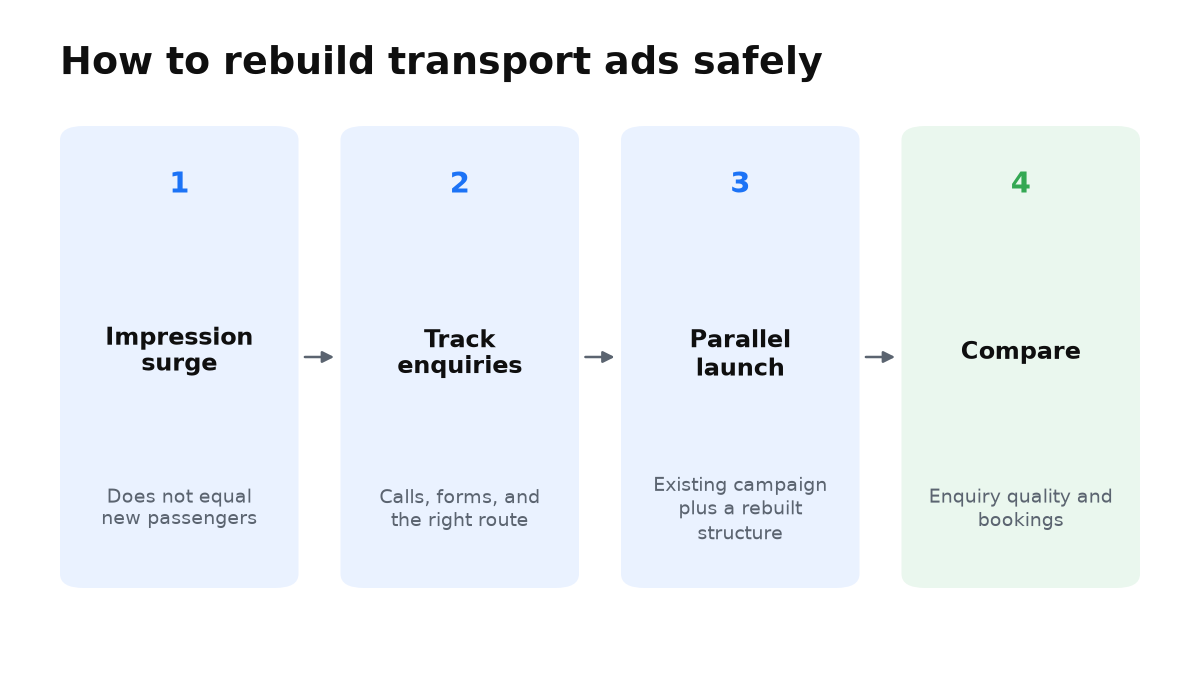
Turning off the existing campaign is risky when it may still bring some passengers and earlier enquiry attribution is incomplete. Yuri’s team built two new campaigns but kept the previous one active for comparison. His reason was simple: «while it’s working, we decided to leave it so we don’t mess it up». In other words, they did not want to damage something that was still working.
This parallel launch creates a practical reference point, not a controlled experiment. Before comparing the campaigns, separate their targeting or use a campaign experiment, define the evaluation period, and compare enquiry quality instead of impression volume. The existing campaign is not labelled a failure simply because its configuration is imperfect.
When Yuri recorded his testimonial, the campaigns were still accumulating data. The honest outcome is therefore not a promised increase in sales. The measurable result at that stage was that the team had found the errors, connected tracking for calls and enquiries, and created a staged plan for rebuilding the account.
When this does not apply
A parallel launch will not fix a situation in which both campaign versions lead to a page with no clear route, schedule, travel terms, or contact method. It also cannot produce a fair comparison without consistent tracking for calls and forms. If abnormal spend is continuing now, contain the financial risk first and check account access, billing, and change history.
Questions from passenger transport owners
Do high impressions mean someone is attacking the ads?
Not necessarily. A surge may come from expanded reach, locations, queries, or placements, but the total alone cannot rule out invalid traffic. Diagnose the source from detailed campaign data.
Should the old campaign be deleted immediately?
Not always. If it still brings enquiries, retain it as a reference, repair measurement, and launch the cleaner structure separately.
Which metric should an owner examine first?
Start with campaign-linked enquiries such as calls, forms, and other intentional contacts. Then compare them with spend, route, and actual bookings in your operating system.
If impressions and spend in your passenger transport account are rising faster than identifiable enquiries, an audit can separate a measurement problem from a traffic problem and provide a safer rebuilding plan.
My e-book “19 Google Ads Secrets”: how to get the most out of Google Ads without draining your budget, drawn from real campaigns and tests.
See the book →