
Callouts are Google Ads assets, formerly known as ad extensions. They add useful text and make an ad more prominent by placing another line below the main link and description. On desktop, the benefits appear in one line separated by dots. On mobile, callouts may occupy a paragraph.
More text alone will not improve an ad. A callout should add information that strengthens the offer and helps a potential customer choose your business.
Where to add callout assets
First decide which ads should be eligible to use the callout. You have three levels:
- Account. A callout at this level can appear across all your campaigns and ads. Use only facts that describe the company as a whole and apply to every product.
- Campaign. This is the most common level because one campaign usually covers a particular service, country, or product type. When choosing what to display, Google gives the campaign callout priority over a general account callout.
- Ad group. Use this level for the unique terms or benefits of a specific product or service. This copy has the highest priority when Google selects a callout for that ad group.
Choose the level according to relevance. Ask which ads can truthfully use the information, whether it applies to every product, and which keywords it supports best.
How many callouts to create
Google recommends at least four callouts for an ad. I recommend setting up five and adding more when possible. With several options available, Google rotates combinations and adapts them to the search text. The report shows how the ad performed when a callout appeared. Since callouts are not clickable, these metrics do not establish the isolated effect of a particular callout.
What I put in callout assets
I use short, verifiable facts that resolve a concern without requiring a separate click. I do not repeat the headline, the call to action, or vague praise for the company. General terms stay at account level, while details of a particular offer go lower in the hierarchy so that an accurate phrase does not appear beside an irrelevant ad group.
Google explains the hierarchy and display settings in its documentation about callout assets.
Evaluate the outcome using concrete metrics:
- the ad’s position in search results and its click-through rate, or CTR;
- cost per click;
- conversions.
Regular analysis can reveal additional ways to improve performance, so do not judge callouts only by how they look in the ad preview.
Additional callout settings
You can set a display schedule for a callout:
- days of the week;
- hours of the day;
- start and end dates.
Most advertisers do not need a schedule. They can make the text universal enough to remain accurate at any time. Scheduling does matter for some businesses, such as food delivery services or restaurants whose menu or price changes during the day.
You can also use a schedule for promotions, time-limited discounts, and special offers tied to a holiday.
What to write in callout assets
A callout should strengthen your ad and give the user unique, useful information about the product or service. Do not write copy simply to fill the available space.
These are weak examples:
- open Monday through Friday;
- open from 9 a.m. to 6 p.m.;
- wide range of products;
- 25 product options;
- all services available.
Write what genuinely distinguishes you from competitors. It could be a service others do not provide or a specific condition of the offer:
- open 24 hours a day, seven days a week, if competitors keep standard business hours;
- certified to work with particular brands or authorized as an official distributor;
- free delivery, an included consultation, an extra, or extended diagnostics.
I have used the following callouts in my own search advertising:
- gift at the webinar;
- concentrated information;
- registration bonus;
- step-by-step launch plan;
- from a Google Partner;
- 15 years of experience.
You can highlight the company, a particular product, or a service. The information should matter to a potential customer and provide another reason to click through to the website.
For a service business, callouts are only one part of the system. My guide to Google advertising for service businesses explains how to structure the entire campaign around acquiring customers.
Google allows up to 25 characters for each callout. Do not try to fill the entire field. Shorter copy allows more callouts to fit into the ad. For example, shorten “free delivery for our customers” to “free delivery.”
If you want these short phrases to become a persuasive part of the ad, sort your benefits by level, shorten every statement, and retain only verifiable differences.
My e-book “19 Google Ads Secrets”: how to get the most out of Google Ads without draining your budget, drawn from real campaigns and tests.
See the book →How to edit a callout
Open “Assets” in the “Campaigns” menu, then “Associations” and “Callout.” To edit the text, click the pencil next to the callout, choose “Edit,” make your changes, and save. Scheduling is under “Advanced options” in the editor. To remove a callout association, return to the “Associations” table, select its checkbox, click “Remove,” and confirm.
Google Ads callout checklist
- Separate benefits across three levels: the whole company, an individual campaign, and a specific ad group.
- Keep only universal statements at account level. They must not conflict with any product.
- Add benefits tied to a particular service, country, category, or customer type at campaign level.
- Use the most precise benefits for ad groups, such as format, timing, bonus, package contents, or delivery terms.
- Reduce each callout to two, three, or four words and confirm that it fits the 25-character limit.
- Remove statements that any competitor could make, such as “wide selection,” “high quality,” or “personal service.”
- After launch, compare CTR, cost per click, and conversions once you have enough data, not after a single day.
Key conclusions about callout assets
Focus on three actions when you set up callouts:
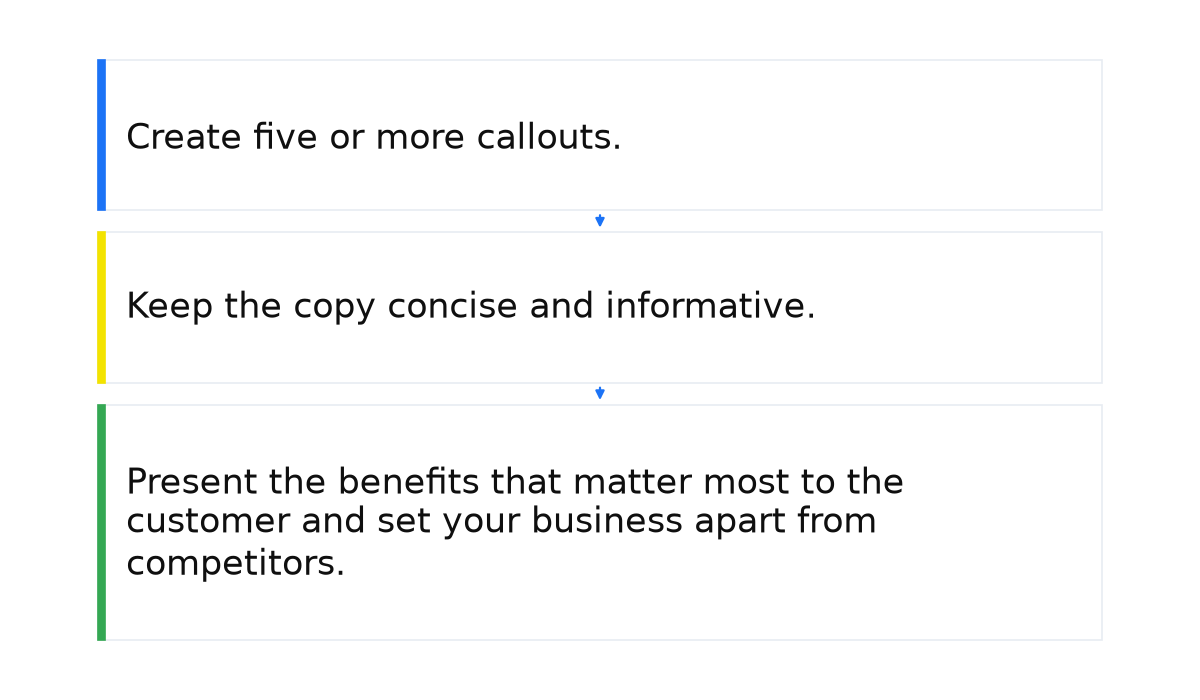
- Create five or more callouts.
- Keep the copy concise and informative.
- Present the benefits that matter most to the customer and set your business apart from competitors.
Do not stop after setup. Analyze how different asset types perform, revise them when necessary, add new options, and remove ineffective ones.